The memories of the Place in the Palm of One’s Hand. Arts Practices and Well-Being
Abstract
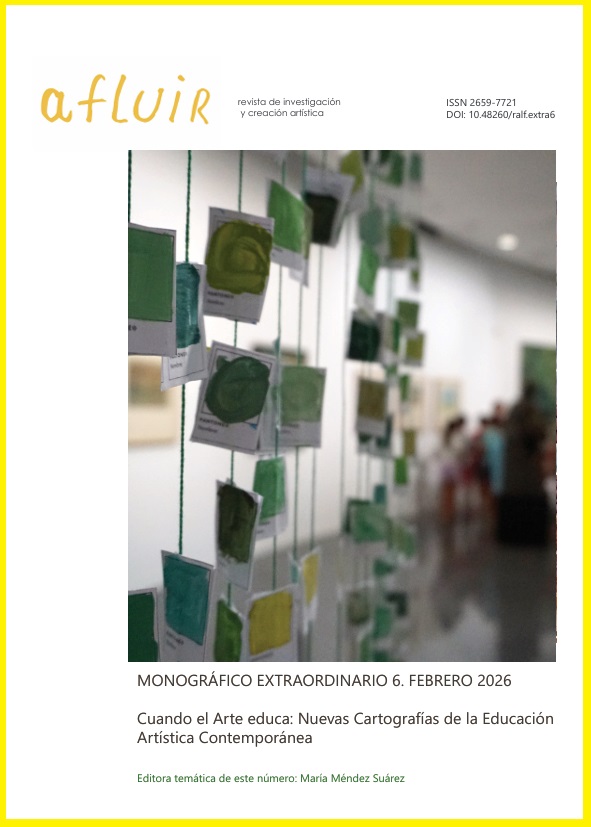
This text describes the working process and the results of a visual arts project developed with a group of women over the age of 65, entitled ‘A Map in the Palm of One’s Hand’. Taking the memory of places as its central theme, the project, embedded in the territory of a city in southern Portugal (Santiago do Cacém), has culminated in an artistic intervention in a public space, in the form of an installation.
Participating in the project were the authors of this article, all as artists, teachers, and researchers; 13 women over the age of 65 and a resident artist who had worked with the group on a project promoting active ageing and who acted as a mediator between the group and those responsible for the project.
Carried out in the form of a workshop and artistic residency, the project focused on contemporary practices in the visual arts and resulted in an installation taking place in a public space in the city centre.
References
Abrams, J. & Hall, P. (2006). Else/Where: Mapping New Cartographies of Networks and Territories. University of Minnesota Design Institute.
All-Party Parliamentary Group on Arts, Health and Wellbeing (2017). Arts Engagement and Wellbeing: Policy Briefing. All-Party Parliamentary Group on Arts, Health and Wellbeing.
Balbin Castillo, M. A.(2024). Libro de artista y a/r/tografía: una experiencia en la residencia de mayores de Cazalilla. Afluir,VIII.pp.19-36. https://dx.doi.org/10.48260/ralf.8.197
Benjamin, W. (1987). Obras Escolhidas. Magia e Técnica, Arte e Política. Editora Brasiliense.
Clift, S. (2012). Creative arts as a public health resource: moving from practice-based research to evidence-based practice. Perspectives in Public Health. 132(3), 120-127. doi:10.1177/1757913912442269
Clift, S. & Camic, P. (2016). Creative arts, health, and wellbeing. International perspectives on practice, policy, and research. Oxford University Press.
Cohen-Cruz, J. (2010). Engaging Performance, Theatre as Call and Response. Routledge.
Corner, J. (1999). Recovering Landscape: Essays in Contemporary Landscape Architecture. Princeton Architectural Press.
Cruz, H. (Coord.) (2019). Arte e Esperança. Percursos da iniciativa PARTIS 2014-2018. Fundação Calouste Gulbenkian.
Cutler, D. (2009). Ageing artfully: Older people and professional participatory arts in the UK. Baring Foundation. https://baringfoundation.org.uk/wp-content/uploads/2009/08/AgeingArtfully.pdf
Fancourt, D., Baxter, L. & Lorencatto, F. (2020). Barriers and enablers to engagement in participatory arts activities amongst individuals with depression and anxiety: quantitative analyses using a behaviour change framework. BMC Public Health 20 (272). https://doi.org/10.1186/s12889-020-8337-1
Fancourt, D, & Saoirse, F. (2019). What is the evidence on the role of the arts in improving health and well-being? A scoping review. Health Evidence Network synthesis report, 67. World Health Organization. https://www.ncbi.nlm.nih.gov/books/NBK553773/pdf/Bookshelf_NBK553773.pdf
Halbwachs, M. (1990). A Memória Coletiva. Vértice.
Hanna, G. & Perlstein, S. (2008). Creativity matters: Arts and aging in America. Americans for the Arts. https://www.giarts.org/sites/default/files/Monograph_Creativity-Matters-Arts-and-Aging-in-America.pdf
Helguera, P. (2011). Education for Socially Engaged Art: A Materials and Techniques Handbook. Jorge Pinto Books.
Jade, L., Larsen, K., Kirkwood, C. & Brown J. (2020). The Relationship is the Project: Working with Communities. Brow Books.
Klimczuk, A. (2016). Creative Aging: Drawing on the Arts to Enhance Healthy Aging. In: Pachana, N. (eds) Encyclopedia of Geropsychology. Springer. https://doi.org/10.1007/978-981-287-080-3_363-1
Leavy, P. (2022). Design Research. Guilford Press
Lemos, I.C. (2020). Envelhecimento (Cri)ativo. Teatro e outras artes performativas. Tese de mestrado em gestão de indústrias criativas. Universidade Católica-Escola de Artes.
Matarasso, F. (2019). Uma Arte Irrequieta. Reflexões sobre o triunfo e importância da prática participativa. Fundação Calouste Gulbenkian.
Moriana, S, S. (2021). El acceso democrático al arte y salud comunitaria: El caso de ARTYS, La Experimental. Tesis Doctoral. Universidad Complutense de Madrid - Faculdad de Bellas Artes
Officer, A.; Hérick de Sá, T. (2023). UN Decade of Healthy Ageing (2021-2030). https://unece.org/sites/default/files/2023-11/9_WHO_UN%20Decade%20of%20Healthy%20Ageing.pdf
Peters, S., & Barnett, T. (2024). Preparing Artists to Save the World: Community-Engaged Arts Practice as Critical Pedagogy. Critical Arts, 38(4–5), 159–174. https://doi.org/10.1080/02560046.2024.2338355
Presidência do Conselho de Ministros (2024). Plano de Ação de Envelhecimento Ativo e Saudável 2023-2026. Diário da República. 1ª série, 9, pp.31-79. https://files.diariodarepublica.pt/1s/2024/01/00900/0003100078.pdf
PORDATA Base de Dados Portugal Contemporâneo. https://www.pordata.pt/pt
Seemann, J. (2013). Mapas, Mapeamentos e a cartografia da Realidade. Revista Geografares 04(4), DOI:10.7147/GEO4.1080
Stock, C. (2000). The Reflective Practitioner: Choreography as Research in an Intercultural Context. in Onuki H.(Ed.). World Dance 2000 - A Celebration of the Millennium: Choreography Today, World Dance Alliance, 209–225.
United Nations (2002). Political Declaration and Madrid International Plan of Action on Ageing. https://www.un.org/esa/socdev/documents/ageing/MIPAA/political-declaration-en.pdf
Vasconcelos et al. (2024). Práticas Artísticas, Envolvimento e Bem-Estar: Projeto Recriar-se. Instituto Politécnico de Setúbal. http://hdl.handle.net/10400.26/52211
Vázquez, C.; Gillanders, C. & De Garayo, S. (2021). Involving student teachers in the recovery of our elders’ memories: a service-learning project in higher education, Journal of Education for Teaching, 47:4, 531-547. https://doi.org/10.1080/02607476.2021.1920830
Victoria Health. 2013. Making Art with Communities: A Work Guide. https://www.vichealth.vic.gov.au/media-and-resources/publications/making-art-with-communities-a-work-guide
World Health Organization (2012). The World Health Organization Quality of Life (WHOQOL).